Continuous capture of raw SAR radar echoes to NVMe Gen4 SSD entirely in FPGA logic, while the downlink transmitter and an optional onboard processor read earlier collects from the same drive at the same time — arbitrated in hardware, with no CPU, no operating system and no external DDR anywhere in the data path.
A SAR satellite captures coherent echo history that only becomes an image after focusing. Capture outruns the downlink by roughly 20×, so the payload must record at full rate and read back at a completely different rate — often at the same moment.
B = c / 2δr≈ 500 MHzIllustrative worked example from public SAR first principles, shown to convey order of magnitude. Real payloads vary with mode, duty cycle, bit depth and quantisation ratio.
Capture outruns all practical downlink options by 20× or more. The SSD is not peripheral storage — it is the mission-critical bus.
Between the radar electronics and the downlink transmitter sits the IDHU — the Image Data Handling Unit. It must accept the full sensor rate, compress, encrypt and store it in real time, then serve that same storage back to the transmitter and to any onboard processor without ever pausing the recording.
Conceptual IDHU architecture on an AMD UltraScale+™ FPGA. The write user and the read users operate on the same SSD at the same time — the recording never stops.
Capture continues at full rate while the transmitter drains earlier collects and a processor reads for focusing. No stop-and-switch, no missed acquisition window, no lost azimuth history.
Command issue, arbitration and data movement are pipeline stages, not tasks awaiting a scheduler. No CPU, no OS, no driver and no external DDR anywhere in the data path.
Space-grade AMD UltraScale+™ devices may not integrate PCIe hard blocks. The optional built-in PCIe Gen4 Soft IP on GTH/GTY transceivers removes that limitation entirely.
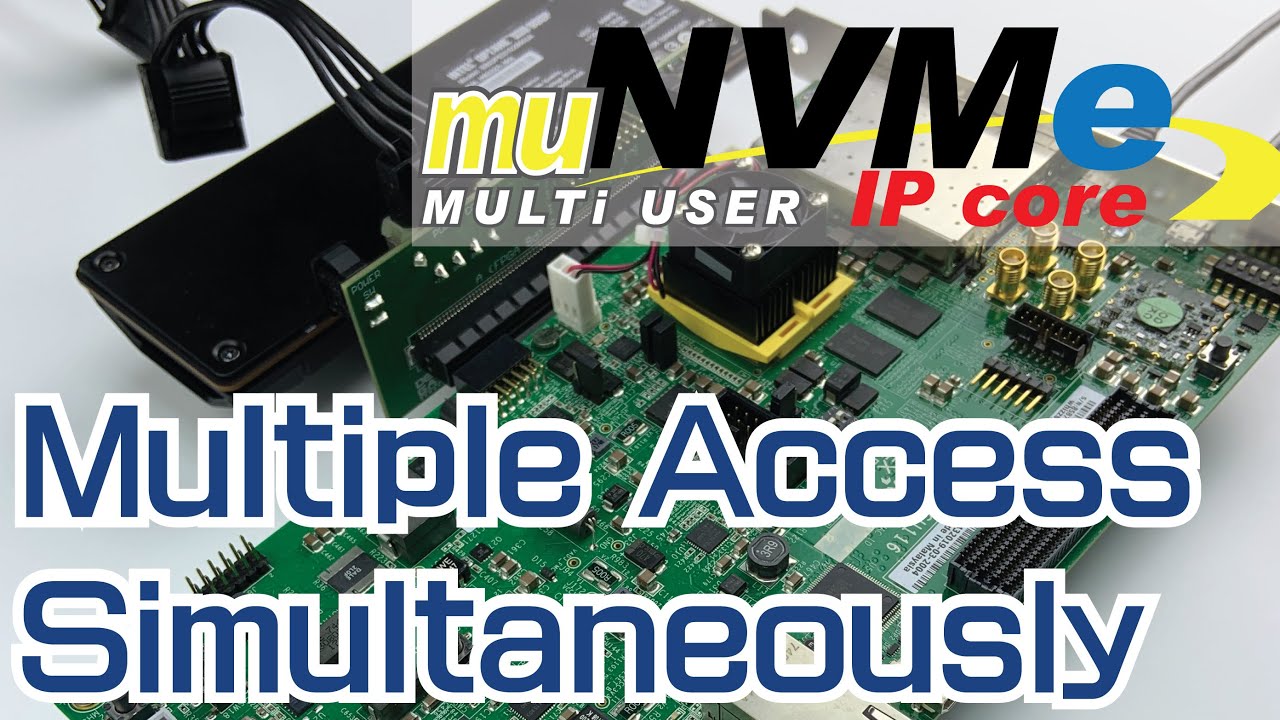
The solution integrates two of Design Gateway's production-proven IP cores — from the multi-user NVMe host controller up to a host-readable file system, entirely in FPGA fabric.
| IP Core | Function | Key Performance |
|---|---|---|

Learn more →
|
Multi-user NVMe host controller with integrated PCIe bridge, interfacing PCIe Gen4 SSD at full bandwidth. Up to four independent users access one SSD simultaneously — the radar writes raw echoes while the downlink transmitter and an onboard processor read earlier collects, all arbitrated in hardware with no CPU, no OS and no external DDR. Optional built-in PCIe Gen4 Soft IP enables Gen4 bandwidth on devices without PCIe Gen4 hard IP. |
~7,000 MB/sPCIe Gen4 NVMe
4 UsersConcurrent R/W · 1 SSD
|
| exFAT2-IP Learn more → | Hardware exFAT file system controller enabling simultaneous write and read access to the NVMe SSD — continuous echo recording on one user while recorded files are read back on another. Collects and derived products land on the drive as standard files, instantly readable on any Windows or Linux ground-segment workstation with no proprietary driver or extraction tool. |
Concurrent R/W2 users, in hardware
Gen4 SSD speedNo CPU file system
|
| Target Device (flight) | AMD UltraScale+™ FPGA |
| FPGA Development Kit |
VCK190 AMD Versal™ AI Core Series — 4-user Gen4 demo KCU116 ZCU106 2-user demos |
| SSD Interface Adapter | AB18-PCIeX16 AB19-M2PCI AB20-U2PCI AB17-M2FMC |
| SSD | NVMe Gen4 SSD — enterprise or industrial grade recommended for sustained full-rate write |
| PC | Windows or Linux PC to mount and read the exFAT volume |
| IP Core | muNVMe-IP (Gen4) exFAT2-IP (Gen4) |
| Reference Design | exFAT2-IP with 2 Users for muNVMe-IP Gen4 |
| External Memory / CPU | None — 256 KB or 1 MB internal buffer per user; the data path is entirely programmable logic |
Time-limited evaluation bitstreams for standard AMD kits — including simultaneous write and read. Directly verify multi-user concurrent access and exFAT file system on real hardware before committing.
For more details, refer to the documentation published on our website.