Design Gateway Hot! News
May 2026(2)
Design Gateway FPGA Storage IP Solutions

The Challenge: Complete SATA Storage Without CPU Software Overhead

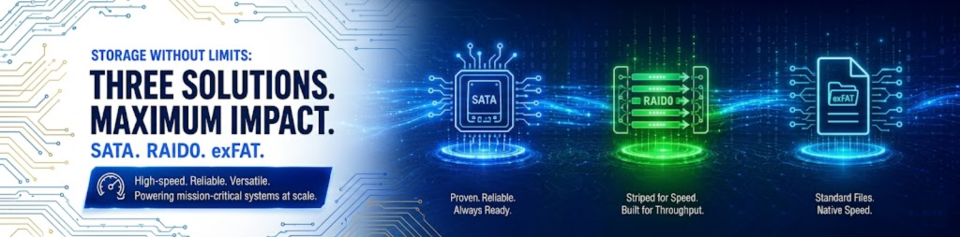
SATA SSD is still a practical choice for long-lifecycle FPGA systems that require proven connectivity, lower power, relaxed PCB routing, and broad SSD availability. However, a raw SATA link is not enough to build a complete storage application. The design must also implement the host-controller layer that manages SATA device access before higher-level functions such as RAID0 striping or a file system can be added. Design Gateway solves this with a layered hardware architecture. SATA-IP handles the SATA protocol and high-speed serial interface. HCTL-IP adds the host-controller layer and command control. On top of SATA-HCTL, Design Gateway provides ready-made top-up modules for RAID0 and exFAT, allowing customers to scale performance, increase capacity, or write standard exFAT files while keeping the data path in FPGA hardware.

Layer SATA-IP HCTL-IP
(Host Controller)
RAID0 / exFAT-IP
(Top-Up)
Role in the Stack Link + transport layers over SATA III Completes the application layer — required for top-up modules Optional add-ons over SATA-HCTL
What It Delivers Direct command/data path to one SATA SSD Host-side command queue, SSD enumeration, control flow RAID0 striping across channels, or exFAT file-system writes
FPGA Footprint Small — transceiver only, no PCIe Hard IP Compact host-controller logic on top of SATA-IP Top-up module — no duplication of lower layers
Scalability One transceiver pair per SSD — easy to replicate One HCTL-IP instance per SATA-IP instance RAID0 supports 4-ch / 8-ch designs; exFAT writes a standard file system
① SATA-IP CORE
Proven, Lean, Reliable
SATA-IP Core block diagram

Key Features

🛡️
Proven Legacy Storage
Deployed for over a decade in mission-critical systems.
🔧
Relaxed Hardware Design
6 Gbps SATA III eases PCB signal integrity and EMC.
🔋
Lower Resource & Power
Small FPGA footprint and lower energy budget.
🔌
Broad FPGA Support
Works with many transceiver-equipped FPGAs — no PCIe Hard IP required.
📈
Scalable Multi-Channel
Add multiple SATA channels for more bandwidth and capacity.
② RAID0 BY SATA-HCTL
Scale Bandwidth & Capacity Across Multiple SATA SSDs
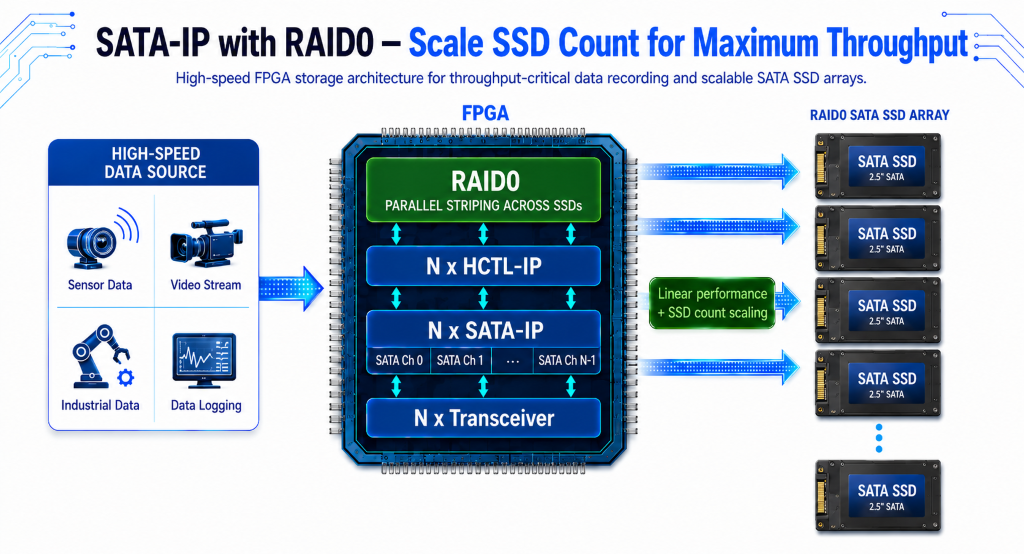
SATA-IP RAID0 architecture with HCTL-IP

What You Get

📈
Linear Scaling
More SATA SSDs & channels increase bandwidth and capacity.
Multi-channel Bandwidth
Multiple SATA-IP channels run concurrently for maximum throughput.
⚙️
Pure FPGA Data Path
No CPU, no OS, no software in the path.
🎁
Free for SATA-IP Customers
Complete RAID0 design with HCTL-IP — no extra license fee.
⬇️
Ready-to-Run Demo Files
Manuals, demo bitstreams, and test results available today.

RAID0 is the most popular way to increase performance and storage capacity in a SATA-based FPGA system. Because the SATA protocol uses only one transceiver pair per SSD, modern FPGAs with many transceivers can easily extend SSD count by adding more SATA-IP + HCTL-IP instances under a single RAID0 controller. Design Gateway delivers the complete RAID0 reference design — including SATA-IP, HCTL-IP, and the RAID0 controller — at no additional charge for SATA-IP customers.

RAID0 Demo Coverage by Board

Vendor Configuration Board / Demo file Document
AMD 4-channel RAID0
SATA-HCTL
Reference Design
AMD 8-channel RAID0
SATA-HCTL
Reference Design
AMD 8-ch RAID0 + DDR
Sustained Rate
Reference Design
Altera 4-channel RAID0
SATA-HCTL
Reference Design
Altera 8-channel RAID0
SATA-HCTL
Reference Design

Video Demonstrations

③ exFAT-IP FOR SATA
Standard File System Without the Software Penalty
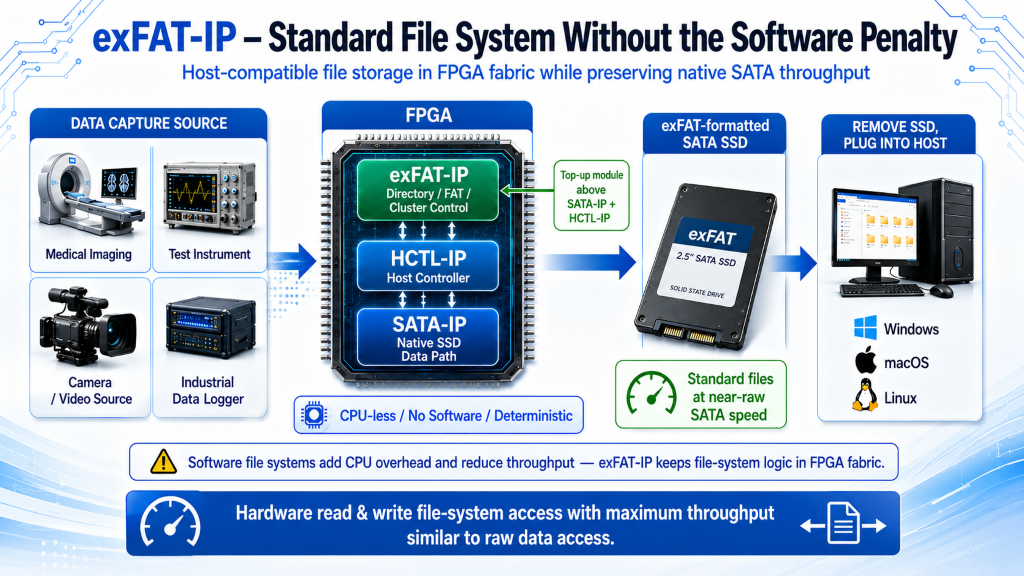
exFAT-IP top-up module for SATA-HCTL

What exFAT-IP for SATA Solves

📁
Standard exFAT Format
Move SATA SSDs to a host PC and browse files directly.
🚀
Maximum SATA Throughput
Write speed stays close to the raw SATA-HCTL path.
🚫
No Software Penalty
No CPU and no software file system in the path.
🎯
Pure Hardware Logic
File-system handling runs entirely in FPGA fabric.

Following the same layered concept as RAID0, exFAT-IP for SATA is implemented as a top-up module over SATA-HCTL. The file-system logic runs entirely in pure hardware on the FPGA, so the maximum throughput of the underlying SATA-IP path is preserved — without the overhead of a software file-system stack. Recorded data lands on the SSD as standard exFAT files, ready to be moved to a host PC and read directly.

exFAT-IP for SATA — Documents & Demos

Vendor Datasheet Reference Design Document Board / Demo file
AMD Datasheet Reference Design ZC706
Altera Datasheet Reference Design Arria 10 SoC / Cyclone 10 GX
AMD
Adaptive Computing Partner
Altera
Solution Acceleration Partner

DG Technology Blog: Get the Latest Insights