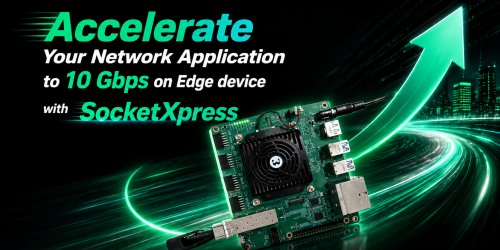
Accelerate Your Network Applications to 10 Gbps on Edge device with SocketXpress

As edge computing applications scale, the demand for 10Gbps throughput is becoming the new standard. However, developers often hit a “CPU wall”—the Linux networking stack simply cannot keep up with 10Gbps speeds, often capping out around 3 Gbps while consuming most of the CPU. At Design Gateway, we’re introducing SocketXpress – a drop-in solution that accelerates TCP/IP applications from ~3...

Sharpening the View from Orbit: AERU-NET’s Adaptive Edge Recovery Approach to Satellite Image Super-Resolution

Research from the CUEE MDAP Lab, published in IEEE Access in March 2025, introduces AERU-Net — a lightweight deep learning model that delivers state-of-the-art super-resolution for satellite and aerial imagery with a fraction of the computational cost of leading alternatives. Satellite and aerial images are essential tools for understanding our planet, but they come with an inherent limitation: resolution. atmospheric...

Accelerate Secure Networking with Hardware-Based QUIC

As network traffic volumes continue to grow and security requirements become more stringent, software-based transport stacks are struggling to keep up. CPU-bound encryption, protocol processing overhead, and limited scalability are now major barriers to achieving full bandwidth utilization. This is where hardware-based QUIC acceleration makes a critical difference. QUIC10GCIP-1GbE from Design Gateway is a fully hardware-implemented QUIC client IP that...

NVMe-IP Gen5 with Micron 9550 SSD: Achieving Sustained 11 GB/s Write Performance

PCIe Gen5 opens the door for extremely high-speed NVMe storage, but achieving this performance in real applications requires more than just a fast interface. The SSD must also be able to sustain high write speed during long continuous transfers. In this demonstration, Design Gateway shows how NVMe-IP for PCIe Gen5 works together with the Micron 9550 enterprise SSD to maintain stable high-speed write performance...

From 1600 MB/s to 6300 MB/s: How we can achieve incredible file system performance?

In traditional FPGA-based Embedded Linux systems, NVMe storage performance typically stalls at ~1,600 MB/s. Why? Because most MPSoCs rely on: The result? A serious performance bottleneck that prevents modern Gen4 SSDs from reaching their true potential. But what if embedded platforms could break that limit? Today, we demonstrate 6,300 MB/s sustained file system write performance on a Linux-based AMD Zynq...

High-Speed File-Based Data Logging for 100G Ethernet Sustained Powered by NVMe-IP for Gen5 and exFAT2-IP

The Challenge: High-Speed Data Logging As network and sensor data rates continue to increase, many data logger systems struggle to maintain sustained recording speed — especially when file system support is required. CPU-based architectures often become the bottleneck, leading to: This FPGA-based data logging project demonstrates a standard, reusable data logger architecture, implemented with 100G Ethernet to clearly showcase high-performance...

Introducing FinoLogic: Finance Logic Acceleration for Modern Financial Systems

Modern financial systems are reaching a critical inflection point. As market data volumes grow, latency budgets shrink, and determinism becomes non-negotiable, traditional software-only architectures are no longer enough. What’s required is a new acceleration layer—designed specifically for finance logic itself. Today, we are proud to introduce FinoLogic™, a new finance logic acceleration platform built to meet the performance, predictability, and...

Offload Edge-to-HTTP/3 Cloud over 1G Ethernet on FPGA with QUIC1G-IP

As edge devices continue to generate massive amounts of data, secure and efficient connectivity from the edge to cloud services has become a critical design challenge. Yet many edge platforms still rely on software-based networking stacks, resulting in high CPU load, unpredictable performance, and long integration cycles. What if your FPGA could connect directly to HTTP/3 cloud services—securely and efficiently—over...

Empowering High-Performance Systems with Gigabit FPGA IP

In today’s data-driven world, performance, determinism, and reliability are no longer optional — they are mission-critical. As data volumes grow and latency requirements tighten, traditional CPU-centric architectures struggle to keep up. This is where FPGA-based IP cores deliver a decisive advantage — enabling hardware-accelerated, deterministic, and scalable system designs across data storage, networking, and security applications. At Design Gateway, we...

Ultra-Low-Latency FPGA Trading with Nasdaq-Developed ITCH & OUCH

In high-frequency trading (HFT), success is measured in nanoseconds.The firms that win are those that see market data first, decide faster, and act with deterministic precision. At Design Gateway, we are pushing FPGA-accelerated trading to the next level with Ultra-Low-Latency Networking IP and Nasdaq-developed ITCH & OUCH protocol acceleration, delivering a true hardware-based trading pipeline — from network ingress to...