High-Speed File-Based Data Logging for 100G Ethernet Sustained Powered by NVMe-IP for Gen5 and exFAT2-IP
The Challenge: High-Speed Data Logging
As network and sensor data rates continue to increase, many data logger systems struggle to maintain sustained recording speed — especially when file system support is required. CPU-based architectures often become the bottleneck, leading to:
- Dropped data and packet loss
- Complex software stacks
- Limited scalability
This FPGA-based data logging project demonstrates a standard, reusable data logger architecture, implemented with 100G Ethernet to clearly showcase high-performance capability.
FPGA-Based Reference Architecture
This project is built as an FPGA-based system, where all time-critical data handling is performed in hardware logic. Incoming data is buffered, processed, and recorded without relying on a CPU for the data path.
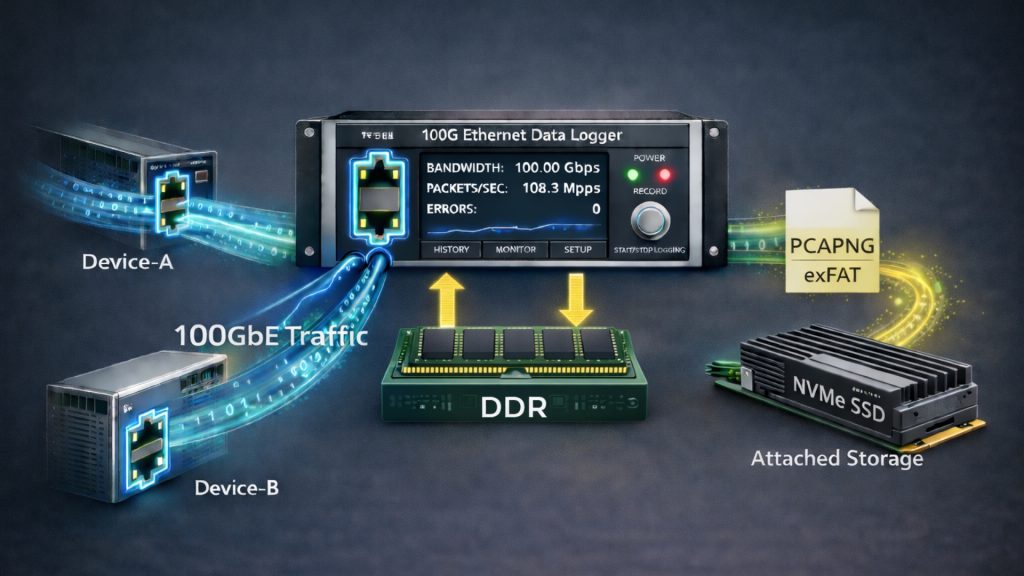
To demonstrate a demanding real-world scenario, the system is implemented as a 100G Ethernet data logger. This closed application allows customers to easily understand system behavior, performance limits, and design advantages — while still serving as a flexible base for other applications.
Watch the YouTube Demo Video
Sustained Recording with DDR Buffering
One of the key challenges in high-speed logging is maintaining a stable, sustained write rate. In this system:
- Incoming Ethernet data is temporarily buffered in DDR memory
- DDR absorbs burst traffic and rate variations
- Data is written to storage at a steady, sustained speed
This buffering mechanism ensures continuous recording without packet loss, even under full line-rate traffic.
High-Speed File-Based Recording (PCAPNG)
Unlike raw data dump solutions, this system records data directly into a standard file system format:
- Packets are converted in FPGA logic into PCAPNG format
- Files are written using exFAT, enabling large-capacity storage
- Recorded files can be opened directly in Wireshark
- No post-processing or conversion is required
This makes captured data immediately usable for analysis, debugging, and validation.
Built on Proven Storage IP Cores
The system is powered by two key IP cores that work together seamlessly:
| IP Core | Key Features |
| NVMe-IP (PCIe Gen5) | High-speed NVMe SSD interface, optimized for sustained continuous write performance, designed for FPGA-based storage acceleration |
| exFAT2-IP | File system support directly in hardware, PC-compatible removable storage, simple data access without special tools |
Together, these IPs combine high-speed recording with easy data retrieval, creating a smooth workflow from capture to analysis.
Packet Filtering via Software Configuration
To improve usability, the system includes packet filtering control through a user application:
- Users can configure filtering rules easily
- No FPGA redesign is required for filter changes
- Only selected packets are recorded, reducing storage load
This makes the system practical for real-world logging and monitoring scenarios.
Scalable on Agilex 7 FPGA Platform
The demo is implemented on an Intel Agilex 7 FPGA board, and the hardware resources can be adjusted to match final system requirements.
Examples of scalability include:
| Component | Demo System | Board Capability |
| Ethernet | 100G Ethernet | Up to 400G Ethernet |
| Memory | Single DDR component | Multiple DDR channels |
| Storage | Single NVMe SSD | Up to 8 NVMe SSDs |
This flexibility allows customers to scale performance without changing the core architecture.
A Reusable Base for High-Speed Data Loggers
While demonstrated as a 100G Ethernet data logger, this FPGA-based system can serve as a base platform for:
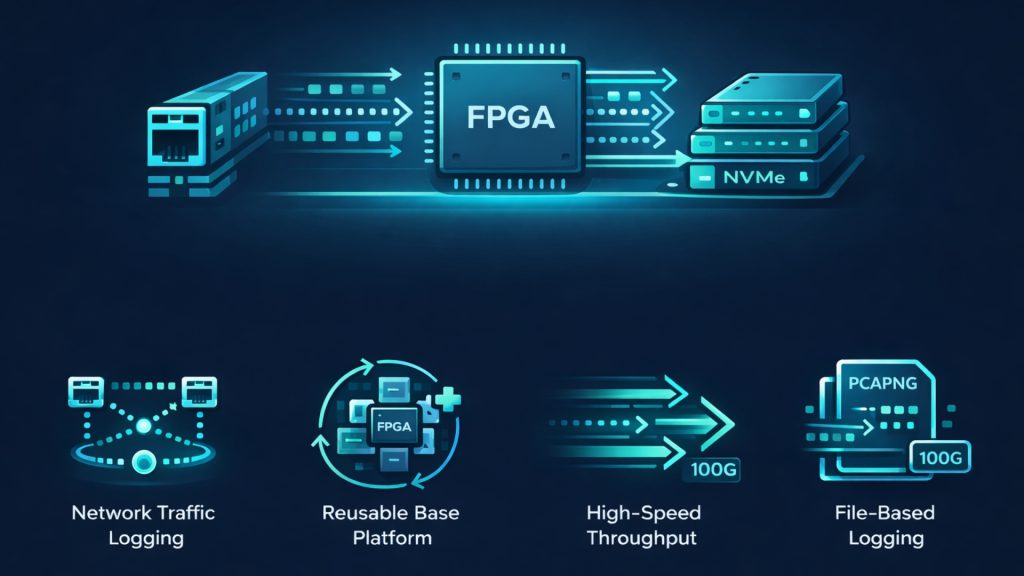
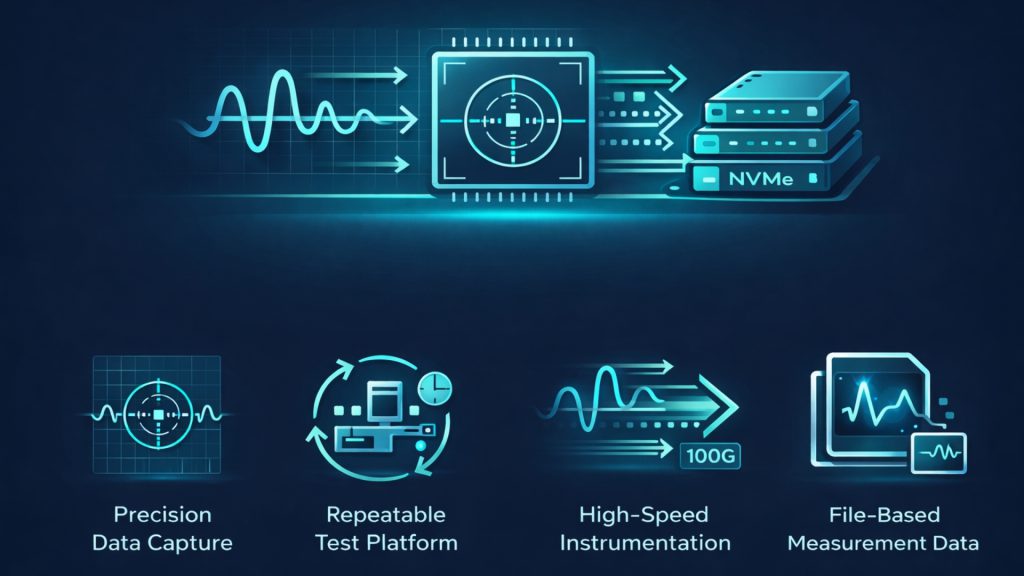
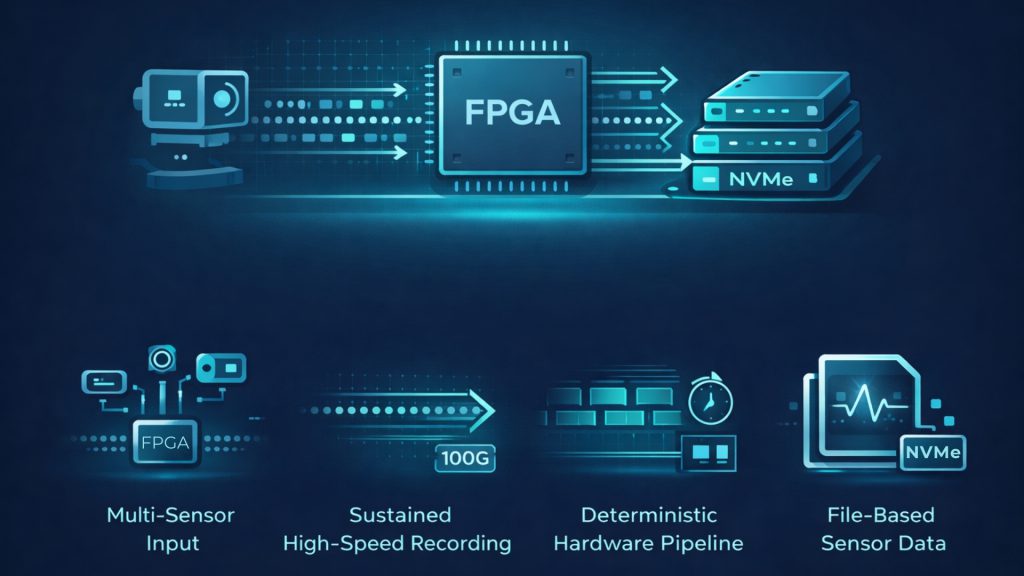
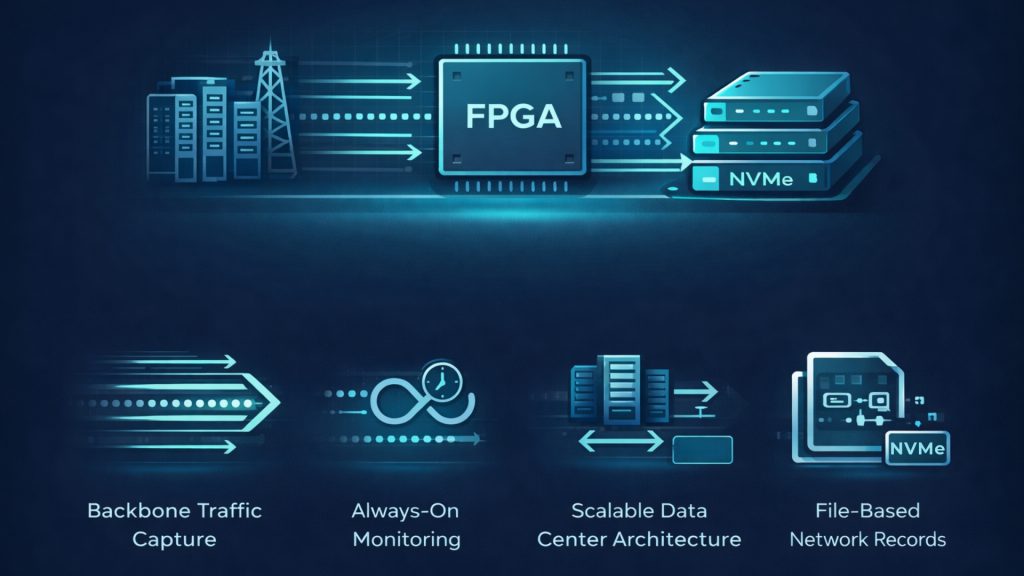
Any application requiring high-speed recording with file system support
📩 Ready to Evaluate?
Contact Us Let’s discuss how this architecture fits your data center or storage project.
📥 Free Evaluation File
Request evaluation materials and test the IP in your environment.
🔗 Product Pages
📄 Technical Documents
- Instruction
🤝 Official Partner Platforms
IP is now available via official Partner Solution platforms:
💬 If you’re working on 100G+ storage logging, feel free to comment or message me