Category: Vertical Market

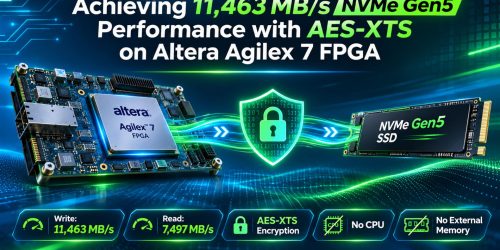
Achieving 11,463 MB/s NVMe Gen5 Performance with AES-XTS on Altera Agilex 7 FPGA

Design Gateway introduces high-bandwidth NVMe Gen5 storage with AES-XTS encryption on Altera Agilex 7 FPGA — using your own key, on any SSD. As storage bandwidth scales up with Gen5 SSDs, protecting sensitive data with your own key inside the FPGA—rather than relying on drive-level encryption—becomes essential. This walkthrough covers how AES-XTS IP and NVMe Gen5 IP operate together on...
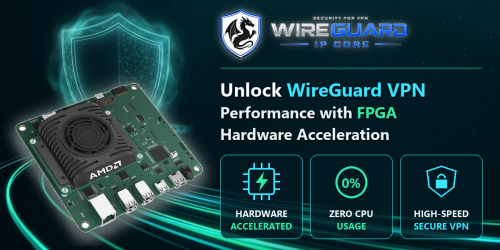
WireGuard 1G IP Core: Hardware-Based Security on AMD FPGA

Secure networking should leave processing power available for your primary application. Design Gateway’s WireGuard1G-IP for AMD FPGAs implements the modern WireGuard VPN protocol directly in programmable logic, delivering a 1 Gbps line-rate hardware engine for robust end-to-end encrypted communication. A ready-to-run 1G evaluation demo is available on the AMD Kria™ KR260 Robotics Starter Kit, offering engineers and system architects a...

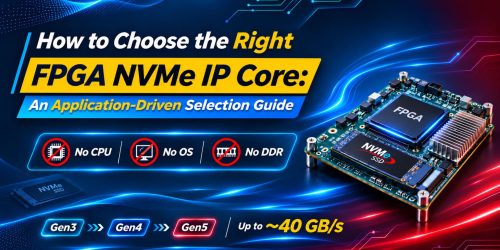
How to Choose the Right FPGA NVMe IP Core: An Application-Driven Selection Guide

Engineered for Pure Hardware Storage Performance: Design Gateway’s all-logic NVMe IP Core family empowers FPGA developers to interface directly with PCIe Gen3, Gen4, and Gen5 NVMe SSDs at wire speed—with zero CPU, zero OS, and zero external DDR RAM overhead. Why FPGA-Native NVMe? Pure Hardware vs. Conventional Host Traditional embedded NVMe designs suffer from CPU bottlenecks, OS driver complexity, and...

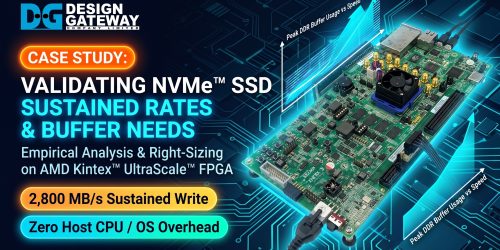
Case Study: Validating NVMe SSD Sustained Throughput and Buffer Needs for Continuous Data Logging

Case Study Overview: In mission-critical edge recording and continuous instrumentation, relying on peak SSD datasheets often results in catastrophic data loss. This case study demonstrates how empirical testing on the AMD Kintex™ UltraScale™ FPGA KCU105 Evaluation Kit using Design Gateway’s NVMe™ SSD Characteristic Test Platform validates sustained read/write throughput and precisely identifies external DDR buffer requirements. Modern high-speed data acquisition...

FPGA-Powered Performance: DG’s IP Solutions for the Broadcasting & Robotics Market

As the broadcast industry evolves to embrace automation and AI, Broadcasting Robotics is rapidly redefining the future of live sports, studio production, and immersive event coverage. From intelligent PTZ cameras and cable-cams to drones and AR/VR robotic arms, these systems demand frame-accurate storage, low-latency networking, deterministic control, and hardened security. This is where Design Gateway (DG) comes in—with a suite...

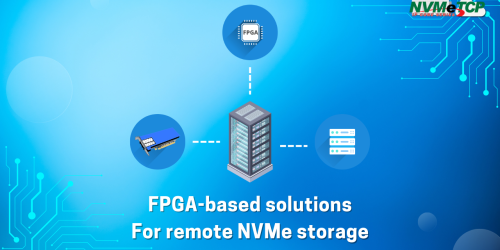
The FPGA-based solutions for remote NVMe Storage access without CPU: NVMe Over TCP Initiator IP Core for 10G/25G/100G network

Advantages of remote NVMe storage:   Remote storage over network can offers many advantages for your FPGA-based systems such as: Why need NVMe/TCP Initiator IP Core on FPGA: NVMe/TCP Initiator requires intensive computation power of CPU to handle NVMe-oF and TCP/IP protocol especially for the application that require very high performance NVMe storage access over 10G/25G and 100G network. NVMe/TCP...

Fully CPU offload for TCP/IP transmission for 10G/25G/40G and up to 100G

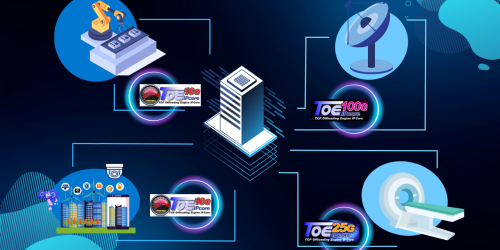
TCP Offloading Engine IP Core provides the full hardware TCP/IP protocol stack engine which is the epochal solution implemented without CPU. TCP/IP function is enable by just controlling simple FIFO interfaces. You can choose suitable line rates from 1G-100Gbps. The latest generation of DG’s TOE100G-IP is capable of full TCP/IP offload and able to achieve 12GB/s without CPU required.Check out our TOE...

TCAM Accelerator for FPGA Based Systems: A High-Performance and Flexible Solution for Various Applications

Ternary Content Addressable Memory (TCAM) is a special type of memory that can store and search data in parallel, using three states: 0, 1, and don’t care (X). TCAM is widely used in applications that require high-speed and complex matching operations, such as network routing, packet classification, pattern recognition, and data compression. However, TCAM also has some drawbacks, such as...

TLS 1.3 Engine for FPGA Based Systems: A High-Security and High-Performance Solution for Data Transmission

Transport Layer Security (TLS) is a protocol that provides encryption and authentication for data transmission over the Internet. TLS is widely used for web browsing, email, online banking, and other applications that require security and privacy. The latest version of TLS, TLS 1.3 (RFC 8446) was published in 2018, bringing significant improvements in security and performance over the previous versions1....