QUIC vs. TCP: Which Performs Better in Lossy Networks?
In our increasingly connected world, reliable internet communication is more critical than ever. Yet, data loss during transmission remains an unavoidable challenge. While TCP (Transmission Control Protocol) has been the backbone of internet communication for decades, it struggles in modern high-speed, loss-prone networks. Enter QUIC — a modern protocol designed to enhance performance and security. But how do these protocols compare under real-world, high-loss conditions? Let’s dive into the findings.
⚔️ The Contenders: TCP and QUIC
This study evaluates the sustained throughput performance of TCP and QUIC in high-loss environments, specifically at a data rate of 10 Gigabits per second (Gbps). The comparison includes three implementations:
- ✅ SW TCP: Traditional TCP tested using iperf3.
- ✅ SW QUIC: Software-based QUIC tested using MsQuic.
- ✅ QUIC IP: A high-performance QUIC implementation from Design Gateway.
The Challenge: Surviving Packet Loss
The first test measured throughput efficiency—how much of the initial performance is retained as packet loss increases. The results were stark.
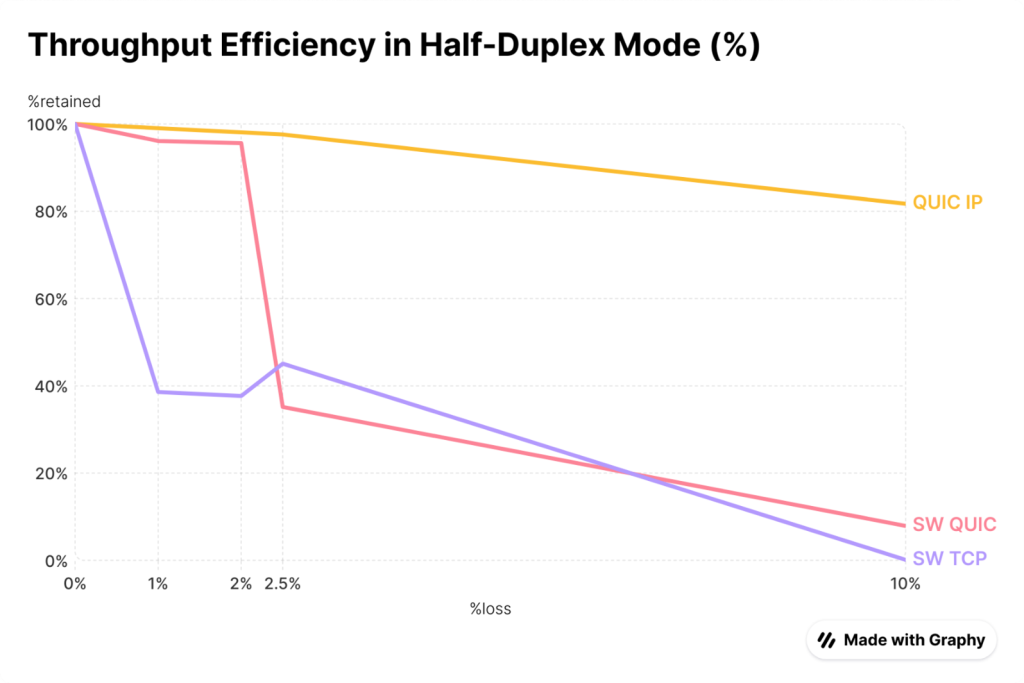
As you can see, both SW TCP and SW QUIC suffered a catastrophic performance drop with as little as 1–2% packet loss. In contrast, QUIC IP shrugged off the loss, maintaining nearly 80% of its throughput even when 10% of packets were lost.

Once again, QUIC IP proved its resilience, retaining over 80% of its performance at 10% packet loss. The software-based solutions, however, couldn’t handle the pressure and their efficiency plummeted.
Beyond Packet Loss: The Out-of-Order Test
Real-world networks aren’t just lossy; packets can also arrive out of order, forcing the protocol to work harder to reassemble the data. This test measured raw throughput (in Gbps).

This is where the difference becomes undeniable:
- SW TCP: Performed well in a perfect “Normal” environment but collapsed under stress.
- SW QUIC: Showed signs of strain even under normal conditions, likely due to high CPU usage, delivering only 2.24 Gbps. Under stress, its performance was negligible.
- QUIC IP: Delivered consistently brilliant performance across the board, achieving over 8 Gbps regardless of the network conditions.
📊 Performance Under Pressure
QUIC IP: The Clear Winner
- Consistent High Throughput: Even with a 10% packet loss in full-duplex mode, QUIC IP maintained over 80% of its performance.
- Robustness: Handled lossy and out-of-order packets with ease, maintaining near-optimal performance.
SW QUIC: A Step Up from TCP, but with Limits
- Moderate Performance: Outperformed TCP in lossy environments but lagged behind QUIC IP.
- CPU Bottlenecks: High CPU usage limited its potential, creating performance bottlenecks.
SW TCP: Struggles in Lossy Conditions
- Ideal Conditions: Achieved high throughput with 0% packet loss.
- Sharp Decline: Performance dropped significantly as packet loss increased, making it unreliable for unstable networks.
🎥 See the Performance for Yourself on YouTube
🧠 Why QUIC IP Stands Out
QUIC IP’s superior performance stems from its advanced design, which minimizes the impact of packet loss and maximizes throughput. Unlike TCP, which is highly sensitive to loss, and SW QUIC, which is constrained by CPU limitations, QUIC IP excels in challenging environments.
The Bottom Line
For modern applications demanding reliable, high-speed communication in unpredictable networks, QUIC IP is the clear choice. While SW QUIC offers better resilience than TCP, its CPU dependency holds it back. TCP, though efficient in lossless scenarios, is unsuitable for loss-prone networks. These findings underscore QUIC IP’s potential as the future of high-performance internet communication.
📞 Ready to Future-Proof Your Network Performance?
Whether you’re building ultra-reliable embedded systems, deploying remote storage for automotive & defense, or just looking for superior QUIC implementation for your FPGA, we’re here to help.
🎯 📩 Contact us today
Let our experts support your next breakthrough in FPGA networking and security!
🧰 Try it yourself with our ready-to-use resources
- 📄 Free evaluation file for AMD: QUIC10GC-IP | QUIC10GS-IP
- 📄 Free evaluation file for Altera: Request
🔍 Learn More About Our Solutions
📘 Technical Deep Dive
📄 Document for AMD:
- 🔹QUIC10GC-IP: Datasheet | Reference Design
- 🔹QUIC10GS-IP: Datasheet | Reference Design
📄 Document for Altera: Request
🔗 QUIC IP is now available via AMD’s official Partner Solution platform.
Let’s build the next generation of high-speed, secure networks—together.