Enabling Remote-Attached Storage on FPGA-Based Embedded Systems over 10G/25GbE
As FPGA-based embedded systems take on more demanding workloads—AI inference, real-time data logging, high-speed sensor ingestion—traditional local SSD storage begins to reveal its limits. Power draw, thermal constraints, space shortages, and maintenance challenges all add up.
But what if your FPGA system could scale seamlessly without carrying the weight of storage media inside the box?
That’s where remote-attached storage with NVMe over TCP (NVMe/TCP) comes in.
Why Remote-Attached Storage for FPGA?
By shifting the storage media outside the enclosure and connecting via 10G or 25G Ethernet, engineers can offload the challenges of heat, power, and scaling—while still maintaining deterministic performance.
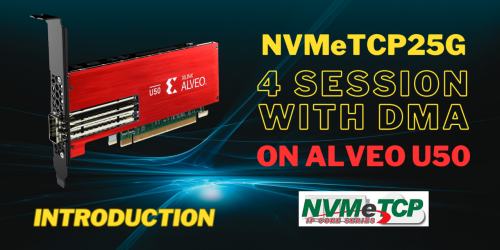
Design Gateway’s NVMeTCP IP Core enables your FPGA to act like it’s talking to a local NVMe SSD, while actually streaming data at line rate to a remote NVMe/TCP server. This approach removes CPU bottlenecks and delivers hardware-level efficiency that software-based solutions simply can’t match.
Key Advantages

Power & Thermal Relief
Eliminate storage heat inside your enclosure, easing cooling design.

Scale Without Redesigns
Upgrade storage on the server side—your embedded design stays lean.

Deterministic Performance
Hardware offload ensures consistent, jitter-free access to storage.
What You Get
- Effortless Integration: Design Gateway’s NVMe/TCP IP Core fully offloads both NVMe-oF and TCP/IP processing into pure hardware. With support for Avalon-Stream and AXI-Stream interfaces, it streamlines data transfer and allows developers to focus on building the core functionality of their FPGA applications instead of protocol complexity.
- Enhanced Power Efficiency: By shifting storage workloads to remote NVMe/TCP servers, your system runs with significantly lower power consumption. This not only reduces heat but also minimizes the need for complicated cooling designs.
- Uncompromised Performance & Scalability: Storage performance and capacity are handled on the remote NVMe/TCP server, freeing your FPGA-based design from on-board storage limitations. The result is a lean, scalable, and future-ready system that adapts as your performance needs grow.
Real-World Applications

Aerospace
Offload massive downlink datasets over 25G Ethernet for centralized analysis.

Automotive Data Recorders
Consolidate storage remotely to preserve bandwidth for cameras and LiDAR.

High-Speed AI & Inspection
Achieve predictable write/read paths from FPGA to storage without CPU variability.
Take the Next Step
🚀 Contact us today to explore how NVMe/TCP storage can transform your FPGA-based design. Our experts are ready to discuss your requirements and help you unlock full potential.
Ready to Try?
🎁 Get your Free Evaluation File and experience firsthand how NVMe/TCP IP Core integrates with your design.
Learn More
Product Page: NVMeTCP IP (AMD) | NVMeTCP IP (Altera)
Technical Documents:
Documents for AMD
- NVMeTCP10G IP (Datasheet) | NVMeTCP10G IP (Reference Design)
- NVMeTCP25G IP (Datasheet) | NVMeTCP25G IP (Reference Design)
Documents for Altera
- NVMeTCP10G IP (Datasheet) | NVMeTCP10G IP (Reference Design)
- NVMeTCP25G IP (Datasheet) | NVMeTCP25G IP (Reference Design)
✅ The NVMeTCP IP Core is now available via the official Partner Solution Platform including AMD/Xilinx and Intel/Altera marketplaces, making it easier than ever to evaluate and deploy.