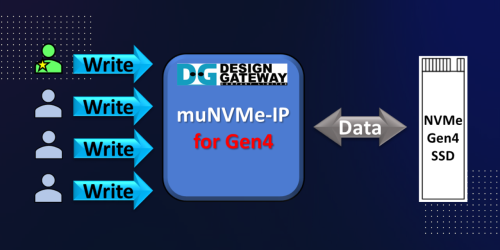
NVMe-IP Gen5 with Micron 9550 SSD: Achieving Sustained 11 GB/s Write Performance
PCIe Gen5 opens the door for extremely high-speed NVMe storage, but achieving this performance in real applications requires more than just a fast interface.
The SSD must also be able to sustain high write speed during long continuous transfers.
In this demonstration, Design Gateway shows how NVMe-IP for PCIe Gen5 works together with the Micron 9550 enterprise SSD to maintain stable high-speed write performance for FPGA-based storage systems.
🎥 Watch the Full Demonstration
See the full NVMe-IP Gen5 demonstration and performance comparison here:
Watch the full demo on YouTube
🚀 The Challenge in High-Speed FPGA Storage
High-speed applications such as sensors, RF receivers, cameras, and measurement instruments can generate massive data streams. In many systems, the FPGA must process this data in real time and stream the processed result directly into storage.
However, not every SSD can handle this workload.
Many commercial SSDs can reach high speed only for a short burst. Once the internal cache becomes full, or when the SSD temperature increases during long continuous transfers, write performance may drop significantly.
The result is simple: even if the FPGA and PCIe interface are fast, the SSD can become the system bottleneck.
💾 What Makes the Micron 9550 SSD Great?
The Micron 9550 enterprise SSD is designed for sustained high-speed workloads. In our NVMe-IP Gen5 demo, it maintains around 11 GB/s sustained write performance, even after transferring 7.6 TB of data.
This makes the Micron 9550 an excellent match for FPGA-based high-speed storage applications where stable long-term write performance is more important than short burst performance.
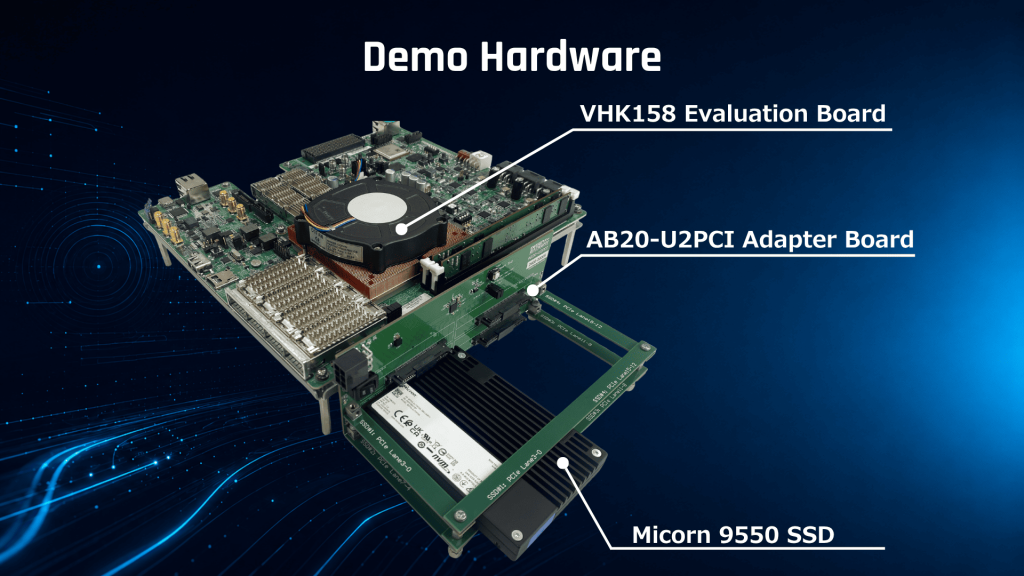
Demo hardware setup using the VHK158 Evaluation Board, AB20-U2PCI Adapter Board, and Micron 9550 SSD.
🏢 Enterprise SSD vs Commercial SSD
Consumer or commercial SSDs are usually optimized for short burst performance. They may look fast at the beginning of the transfer, but their performance can drop during continuous write workloads.
Enterprise SSDs are designed for continuous operation, better thermal behavior, predictable latency, and stable performance over long transfers.
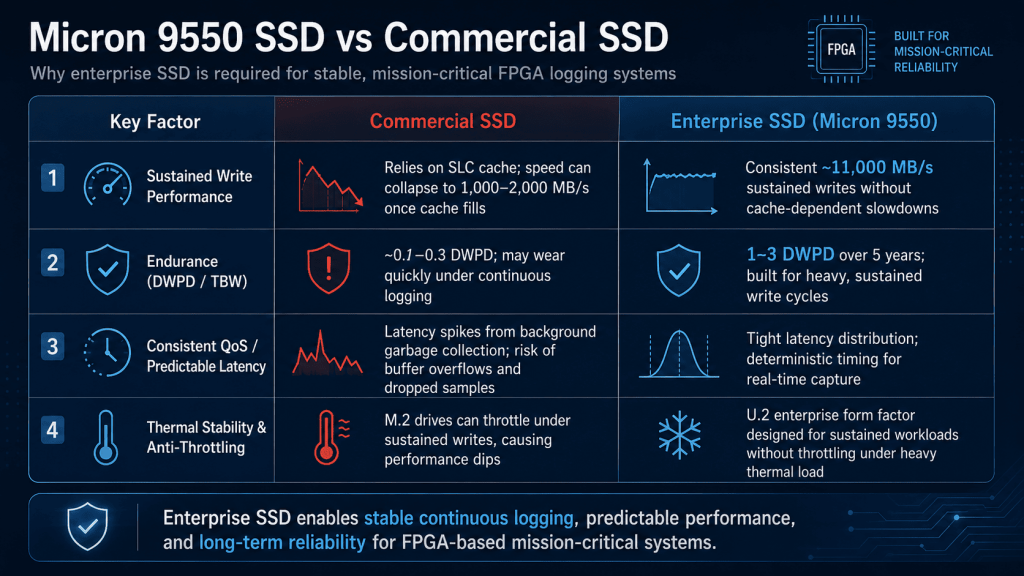
Enterprise SSDs are designed for stable continuous logging, predictable performance, and long-term reliability in FPGA-based mission-critical systems.
📊 Sustained Write Performance: Micron 9550 vs Commercial SSD
To clearly show the difference, we tested the Micron 9550 SSD against a commercial SSD using the same NVMe-IP Gen5 environment.
Both SSDs can reach high write speed at the beginning, but their sustained performance is very different during long transfers.
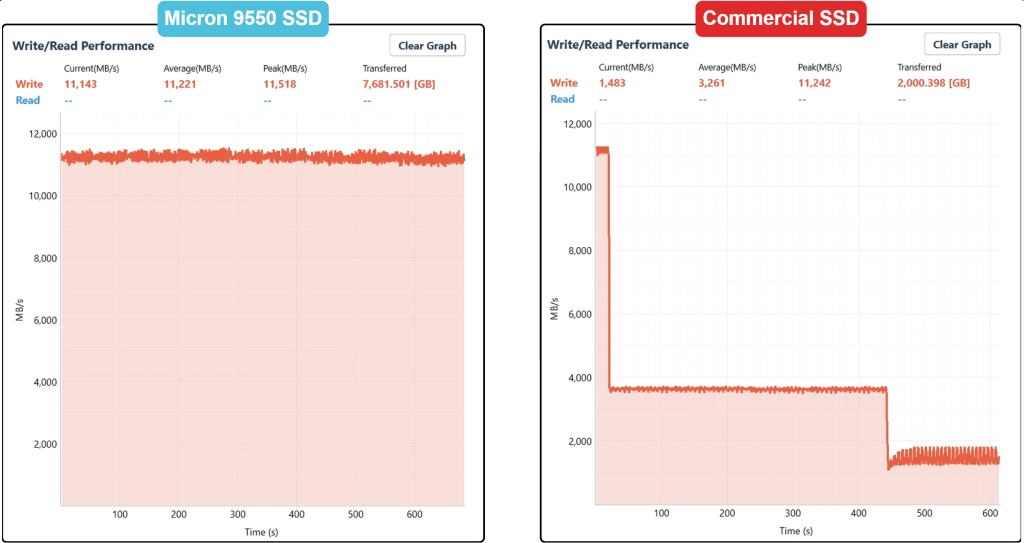
The Micron 9550 maintains around 11 GB/s write performance, while the commercial SSD drops significantly during the continuous write test.
✅ Real Performance Results
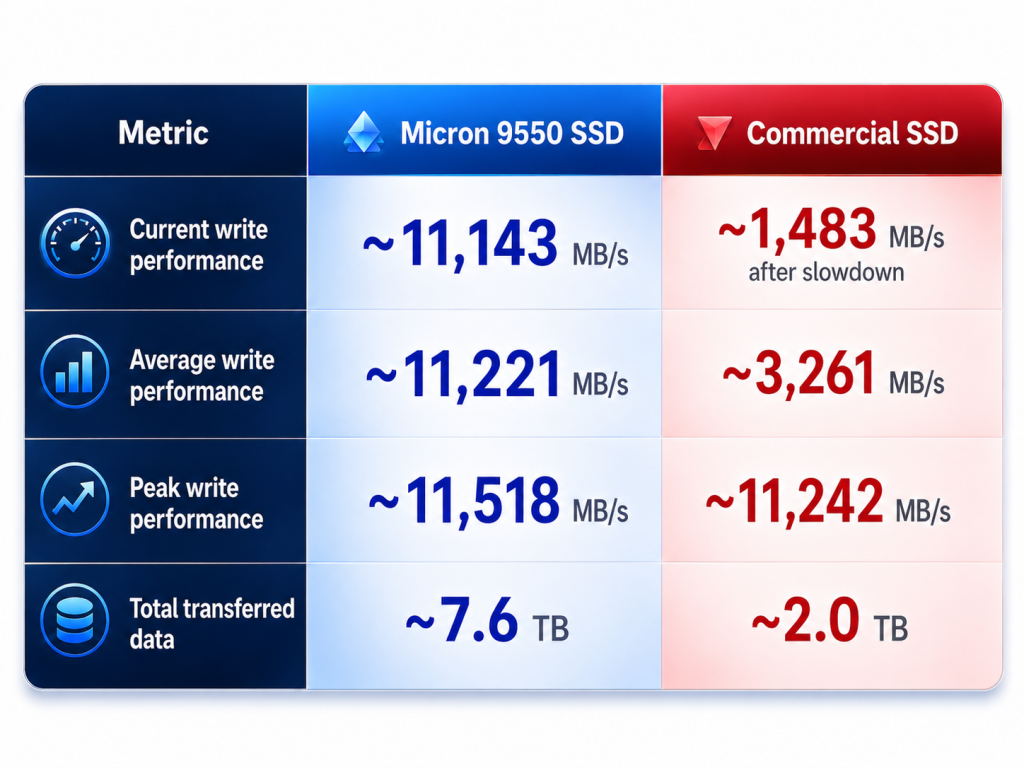
As shown in the result, the Micron 9550 maintains around 11 GB/s write performance throughout the full 7.6 TB transfer. In contrast, the commercial SSD starts with high peak performance, but its write speed drops significantly during the test.
This shows why enterprise SSD selection is important when demonstrating sustained PCIe Gen5 storage performance.
🧠 Why This Matters for NVMe-IP Gen5
By combining Design Gateway’s NVMe-IP Gen5 with the Micron 9550 SSD, the FPGA can stream data directly to NVMe storage at sustained PCIe Gen5 speed without relying on CPU or software overhead.
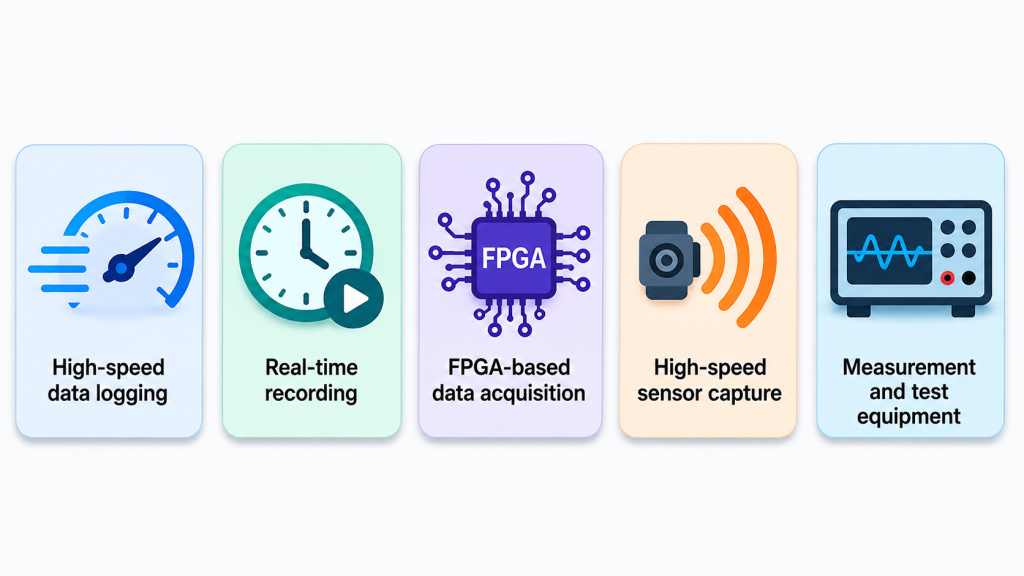
This makes the solution suitable for applications such as:
🎯 Final Takeaway
The Micron 9550 is not just fast at the beginning of the transfer. It is built to keep the performance stable.
That is why it is a strong SSD choice for demonstrating the real sustained capability of NVMe-IP for PCIe Gen5.
📩 Ready to Achieve the Maximum Potential of Your FPGA Storage System?
If you are developing high-speed FPGA-based storage solutions, do not settle for performance drops.
📩 Contact Us
👉 Contact Design Gateway today
Let’s discuss your next project and explore how our rmNVMe IP solutions can empower your storage.
🔗 Learn More About NVMe-IP Gen5
Product Page
👉NVMe-IP Gen5 (AMD) | NVMe-IP Gen5 (Altera)
Technical Documents
👉 Datasheet (AMD) | Reference Design (AMD)
👉 Datasheet (Altera) | Reference Design (Altera)
🆓 Free Evaluation File
Start your evaluation with reference designs and demo environments:
👉 Request a free evaluation package
🤝 Official Partner Platform Availability
NVMe-IP solution is officially available through:
✅ AMD Adaptive Computing Partner Solution
✅ Altera (FPGA) Partner Solution
Ensuring ecosystem compatibility, and enterprise-grade reliability.